National Stock Numbers and Commodity Classification: Getting the Designation Right the First Time

Article Summary
A National Stock Number is a unique 13-digit identifier assigned to every item of supply in the federal logistics system. The first four digits—the Federal Supply Classification code—categorize the item by type and drive how it is procured, stored, shipped, maintained, and disposed of. An incorrect FSC assignment embeds the error into the system where it replicates every time the NSN is referenced across the federal supply chain.
Items in defense-related FSC groups may carry ITAR or EAR classification requirements that affect how they can be transferred, exported, or released to foreign partners. An item cataloged under the wrong FSC code may be missed entirely in export control reviews—and an item with no documented ECCN or USML classification creates a compliance gap when it later enters an export or foreign-release transaction, potentially constituting an unlicensed export.
Not every NSN-cataloged item has been reviewed for ITAR or EAR classification. When a cataloged item without a documented classification determination enters an export or foreign-release transaction, the absence of that determination is not a neutral starting point—it is a compliance gap that places the burden of classification on the transaction handler at the worst possible time, under the worst possible time pressure, with no prior analytical record to support the determination.
Items cataloged years ago may have shifted regulatory jurisdiction—for example, through the ITAR-to-EAR migration under Export Control Reform—or may now fall under new controls that did not exist at the time of original cataloging. The NSN does not automatically update when the regulatory landscape changes, meaning that items may be cataloged under a classification regime that no longer accurately reflects their current export control status.
Classification should be reviewed at the point of cataloging rather than after the NSN is established—corrections to cataloged items are significantly more burdensome than getting the designation right initially. Additionally, items in defense-adjacent FSC groups should be flagged for periodic export control classification review, particularly those potentially affected by ITAR-to-EAR jurisdiction migration under Export Control Reform.
Government contractors and suppliers feeding the federal supply system are responsible for ensuring that their technical data packages include accurate classification information—including FSC codes, ECCN determinations, and USML assessments where applicable. Downstream users throughout the federal supply chain rely on this information for procurement, logistics, foreign release, and export compliance decisions, and errors introduced at the supplier level propagate through every downstream transaction that references the NSN.
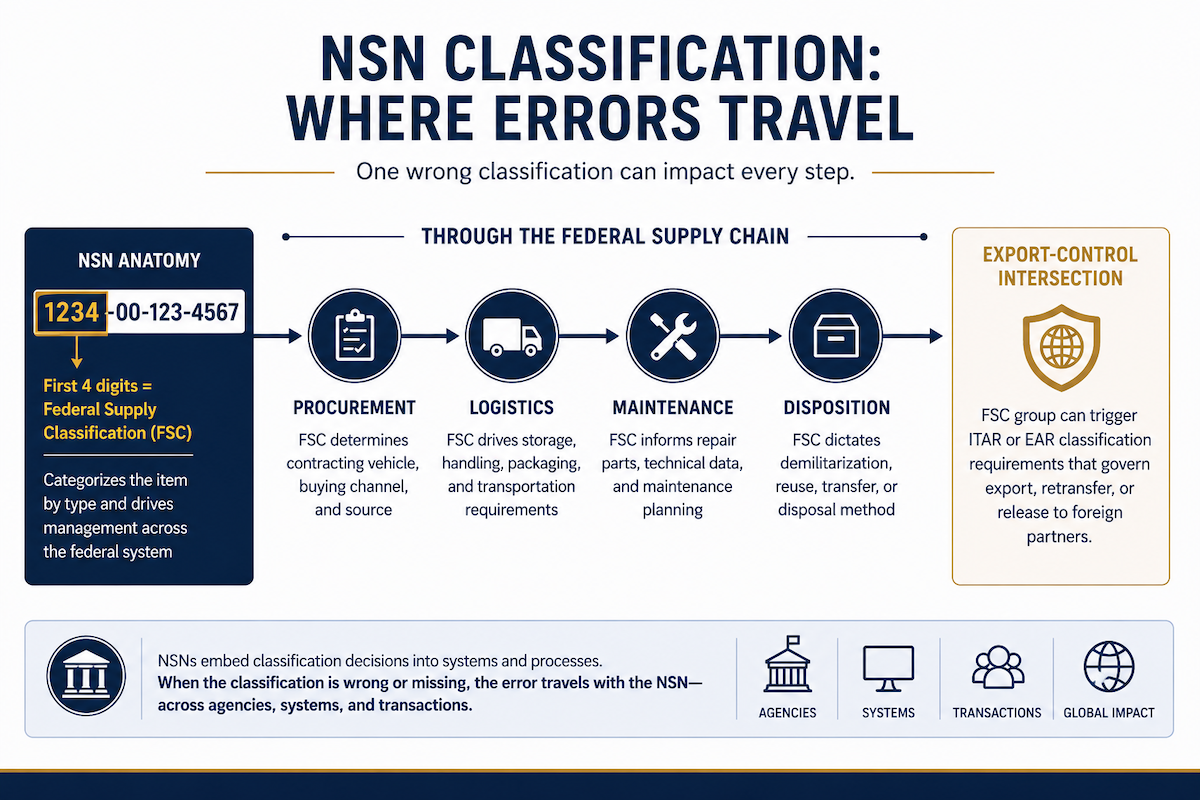
A National Stock Number follows an item through the entire federal supply chain: procurement, logistics, maintenance, and disposition. If the commodity classification behind that NSN is wrong, the error doesn't stay in one place.
The National Stock Number (NSN) system assigns a unique 13-digit identifier to every item of supply in the federal logistics system. The first four digits: the Federal Supply Classification (FSC) code, categorize the item by type. That classification drives how the item is procured, stored, shipped, maintained, and ultimately disposed of. It also intersects with export-control classification: items in defense-related FSC groups may carry ITAR or EAR classification requirements that affect how they can be transferred, exported, or released to foreign partners.
Where this goes wrong:
- Incorrect FSC assignment. An item assigned to the wrong Federal Supply Class may be procured under the wrong contract vehicle, stored incorrectly, or missed entirely in export-control reviews. The error is embedded in the system and replicates every time the NSN is referenced.
- Missing the export-control link. Not every NSN-cataloged item has been reviewed for ITAR or EAR classification. When a cataloged item later enters an export or foreign-release transaction, the absence of a classification determination creates a compliance gap and a potential violation.
- Outdated classifications. Items cataloged years ago may have shifted jurisdiction (e.g., ITAR-to-EAR migration under the Export Control Reform initiative) or may now fall under new controls. The NSN doesn't automatically update when the regulatory landscape changes.
What to do:
- Review commodity classification at the point of cataloging, not after the NSN is established. Corrections to cataloged items are significantly more burdensome than getting it right initially.
- Cross-reference FSC codes with ECCN and USML classifications for items that may be exported or transferred to foreign partners, foreign militaries, or international programs.
- Flag items in defense-adjacent FSC groups for periodic export-control classification review, especially items affected by the ITAR-to-EAR migration.
- If you're a government contractor or supplier feeding the federal supply system, ensure your technical-data packages include accurate classification information. Downstream users rely on it.
CTP supports commodity classification, NSN review, and export-control alignment for items in the federal supply chain. [Request a classification review →]
Key Points
How does an incorrect Federal Supply Classification code create compliance and operational failures that propagate through the federal supply chain, and why are corrections after cataloging so much more burdensome than initial accuracy?
The FSC code embedded in an NSN is not a label that can be corrected without consequence—it is the foundational classification on which every subsequent procurement, logistics, and export compliance decision is built, making initial accuracy a system-level compliance requirement rather than a cataloging administrative standard:
- Procurement vehicle misdirection arising from FSC code errors routing items to contract vehicles, acquisition programs, and procurement channels designed for different item categories whose terms, pricing structures, and compliance requirements do not match the item's actual characteristics — The FSC code determines which procurement vehicles are available for an item—which General Services Administration schedules, which defense logistics agency contracts, and which agency-specific acquisition programs apply; an item assigned to the wrong FSC code may be procured under a contract vehicle whose terms, compliance requirements, and vendor qualifications are designed for a different item category, creating procurement irregularities that the FSC error generates independently of any intentional compliance failure.
- Storage and handling specification errors arising from FSC misclassification directing logistics personnel to apply storage, handling, and transportation requirements designed for different item categories to an item whose actual characteristics require different treatment — Federal supply system storage and handling specifications are tied to FSC classifications; an item assigned to the wrong FSC code may be stored under conditions inappropriate for its actual characteristics, handled by personnel trained for different item types, or transported under specifications designed for different hazard profiles; the FSC-driven storage and handling error is embedded in the logistics system and replicates every time the item is requisitioned, stored, or shipped without independent technical verification of the item's actual characteristics.
- Export control review bypass arising from FSC misclassification placing an item outside the defense-related FSC groups that trigger export control classification review in federal supply system transaction processing — Federal supply system export control reviews are typically triggered by FSC code ranges associated with defense-related item categories; an item whose actual characteristics place it in a defense-related FSC group but which is cataloged under a commercial FSC code may bypass the export control review triggers that its correct classification would have activated, creating a systematic compliance gap in which defense-relevant items proceed through foreign release and export transactions without the ECCN or USML review their actual characteristics require.
- Technical data package error propagation distributing incorrect classification information to downstream users who rely on contractor-provided technical data packages for procurement, maintenance, and export compliance decisions without independent classification verification — Government contractors who provide technical data packages with incorrect FSC, ECCN, or USML classification information distribute that error to every downstream user who references the package—including procurement officers who award contracts based on package specifications, logistics personnel who store and handle items based on package requirements, and export compliance personnel who determine foreign release eligibility based on package classification documentation; the error propagates through the supply chain at the speed of technical data package distribution.
- Correction burden disproportionality making post-cataloging classification corrections substantially more operationally disruptive than initial accuracy — Correcting an NSN classification after it has been cataloged and referenced in procurement, logistics, and maintenance systems requires updating records across multiple federal systems, notifying downstream users of the correction, assessing whether prior transactions conducted under the incorrect classification require remediation, and in some cases revisiting foreign release and export decisions made based on the incorrect classification; the correction burden grows with the number of transactions that have referenced the NSN since incorrect cataloging, making the operational cost of correction substantially higher than the investment in initial classification accuracy.
- Lifecycle classification maintenance obligation extending accuracy requirements from initial cataloging through every regulatory change, product modification, and jurisdiction migration that affects the item's classification during its federal supply system lifecycle — NSN classification accuracy is not a one-time achievement at cataloging but a lifecycle maintenance obligation; regulatory changes—including Export Control Reform jurisdiction migrations, new USML category revisions, and emerging technology control additions—can change the classification status of a cataloged item without triggering any automatic NSN update; lifecycle classification maintenance requires monitoring regulatory developments against the item characteristics of cataloged items and updating NSN classification records when regulatory changes affect classification status.
How does the intersection of FSC classification and export control classification create compliance gaps for items in defense-related federal supply groups, and what cross-reference analysis does closing these gaps require?
The intersection of FSC and export control classification is where federal supply system compliance and export control compliance most directly interact—and the gaps at this intersection are among the most consequential in government contractor compliance programs because they affect foreign release and export transactions for items that may have significant military capability:
- Defense-related FSC group identification as the threshold step for determining which NSN-cataloged items require cross-reference analysis against ECCN and USML classifications — Not all NSN-cataloged items require detailed export control classification cross-reference—items in purely commercial FSC groups with no defense application potential present limited export control intersection risk; identifying which FSC groups contain items with potential ITAR or EAR classification implications is the starting point for prioritizing cross-reference analysis; defense-related FSC groups—covering weapons systems, aircraft components, communications and detection equipment, electronics, and related categories—warrant systematic cross-reference analysis while commercial FSC groups may require only threshold screening.
- ECCN cross-reference analysis connecting FSC-classified items to their applicable Export Control Classification Numbers to identify which items are controlled under the EAR and what licensing requirements apply to their export or foreign release — FSC codes and ECCNs are parallel classification systems with no automatic cross-reference; an item's FSC code does not determine its ECCN, and items in the same FSC group may carry different ECCNs based on their specific technical characteristics; cross-reference analysis requires evaluating each item's technical specifications against applicable CCL control parameters to determine its ECCN independently of its FSC classification, and documenting the cross-reference determination in the technical data package and NSN record.
- USML residual jurisdiction analysis confirming that defense-related FSC items have been evaluated for ITAR jurisdiction and that items currently cataloged under EAR-compatible classifications are not actually subject to ITAR controls based on their technical characteristics and design history — Items in defense-related FSC groups may be subject to ITAR jurisdiction that FSC classification does not reflect—particularly items that were designed for military applications, modified for military specifications, or whose technical characteristics meet USML category control parameters; USML jurisdiction analysis for defense-related FSC items requires technical specification review against USML category descriptions and is a required cross-reference step for any item in a defense-adjacent FSC group that may enter foreign release or export transactions.
- Export Control Reform migration tracking identifying NSN-cataloged items that have transitioned from ITAR to EAR jurisdiction through the 600 series and 9x515 ECCN migration and ensuring that NSN classification records reflect current jurisdiction — Export Control Reform's ITAR-to-EAR migration moved specific defense articles from USML control to CCL 600 series and 9x515 ECCNs; NSN-cataloged items affected by this migration require classification record updates that reflect the current EAR jurisdiction—including the specific 600 series ECCN applicable to the item—rather than the ITAR jurisdiction that applied at the time of original cataloging; items whose NSN records still reflect pre-ECR ITAR classification may be managed under an incorrect compliance framework that produces unnecessary licensing overhead and restricts market access that the ECR migration was designed to enable.
- Foreign military sales and international program cross-reference analysis identifying which NSN-cataloged items are designated for foreign military sales programs or international logistics support arrangements and ensuring that their classification supports the specific foreign release and transfer activities these programs require — Items designated for foreign military sales or international logistics support programs require classification analysis that confirms their eligibility for the specific foreign release, transfer, and export activities these programs involve; classification gaps that are tolerable for domestic supply chain transactions become acute compliance exposures when items enter FMS or international program transactions where foreign release eligibility, retransfer restrictions, and end-use monitoring requirements all depend on accurate classification.
- Periodic cross-reference audit program systematically reviewing defense-related FSC item classifications against current export control requirements rather than relying on initial cross-reference determinations to remain accurate through regulatory change — Cross-reference analysis conducted at initial cataloging does not remain current through the regulatory changes, product modifications, and jurisdiction migrations that affect classification status during an item's federal supply system lifecycle; periodic cross-reference audit programs that review defense-related FSC items against current ECCN and USML classification requirements—triggered by regulatory change monitoring and scheduled review cycles—maintain cross-reference accuracy rather than allowing classification drift to accumulate between periodic reviews.
What specific risks do outdated NSN classifications create, and how should government contractors and agencies approach classification currency maintenance for long-lifecycle federal supply items?
Long-lifecycle federal supply items present classification currency challenges that commercial trade compliance programs are not designed to address—because NSN-cataloged items may remain in the federal supply system for decades while the regulatory frameworks that determine their classification status change multiple times:
- Export Control Reform migration gap creating classification currency failures for items whose NSN records reflect ITAR classification that has since been superseded by EAR 600 series or 9x515 ECCN jurisdiction through the ECR initiative — The Export Control Reform initiative's ITAR-to-EAR migration occurred over several years and affected thousands of defense items; NSN records for affected items that were not updated during the migration transition may still reflect ITAR classification that no longer accurately represents the current regulatory regime; items managed under outdated ITAR classification may be subject to unnecessary DDTC registration and licensing requirements that ECR eliminated, while the 600 series ECCN obligations that replaced ITAR controls may not be reflected in the compliance procedures applied to these items.
- New technology control additions creating classification currency failures for items whose characteristics now fall within new EAR control categories that did not exist at the time of original cataloging — BIS periodically adds new control categories to the CCL reflecting emerging technology concerns—including advanced computing, AI-enabled systems, and quantum technology applications; items cataloged before new control categories were established may not have been evaluated against the new control parameters even if their characteristics place them within the new category's scope; classification currency maintenance must monitor new CCL additions against the characteristics of cataloged items to identify classification gaps created by regulatory expansion.
- Product modification classification impact creating currency failures when items are modified, upgraded, or retrofitted in ways that change their technical characteristics in ways relevant to export control classification without triggering automatic NSN classification review — Federal supply system items are frequently modified, upgraded, and retrofitted over their operational lifecycles; modifications that change an item's performance specifications, materials composition, or functional capabilities may cross ECCN or USML control thresholds without triggering any automatic classification review; classification currency maintenance must establish modification notification protocols that route engineering changes through export control classification review before modified items enter the federal supply system under their prior classification.
- Sanctions and restricted country designation changes affecting the foreign release eligibility of NSN-cataloged items for specific international partners without triggering automatic classification record updates — Changes in U.S. sanctions programs and restricted country designations affect which foreign partners are eligible to receive specific NSN-cataloged items regardless of the item's export control classification; classification currency maintenance must track sanctions and country designation changes against the foreign partner populations for which NSN-cataloged items are designated in international logistics support arrangements and FMS programs.
- Disposition classification accuracy requirements applying export control analysis to NSN-cataloged items at the end of their federal service life when demilitarization, sale to foreign governments, or commercial disposition may trigger export control or ITAR decontrol requirements — Items reaching the end of their federal supply system lifecycle face classification accuracy requirements at disposition that are as significant as those at procurement; demilitarization requirements, decontrol determinations, and foreign government sales involve export control analysis that depends on current classification accuracy; items with outdated classifications may be disposed of under incorrect demilitarization standards, decontrol procedures, or foreign sales authorization frameworks that the current classification would not support.
- Regulatory change monitoring infrastructure as the operational prerequisite for classification currency maintenance requiring systematic tracking of BIS and DDTC regulatory developments against the NSN-cataloged item portfolio — Classification currency maintenance cannot be conducted reactively—waiting for foreign release transactions to surface classification gaps—without accepting the compliance exposure that reactive discovery creates; proactive regulatory change monitoring that tracks BIS CCL updates, DDTC USML revisions, Export Control Reform developments, and new technology control additions against the characteristics of NSN-cataloged items enables proactive classification review before regulatory changes create compliance gaps in pending transactions.
What responsibilities do government contractors and suppliers have for ensuring NSN classification accuracy in their technical data packages, and what downstream compliance consequences does contractor-provided classification error create?
Government contractors who provide NSN cataloging data and technical data packages occupy a critical position in the federal supply chain's classification accuracy—because errors introduced at the contractor level propagate through every downstream transaction that references the contractor-provided information:
- Technical data package classification accuracy obligation requiring that contractor-provided NSN cataloging submissions include accurate FSC, ECCN, and USML classification information supported by documented technical analysis — Government contractors who submit NSN cataloging data to the Defense Logistics Agency or other cataloging authorities provide the classification foundation on which federal supply system users rely; technical data packages that include incorrect FSC codes, undetermined ECCNs, or unresolved USML assessments introduce classification errors at the point of maximum leverage—the initial cataloging—where correction is most burdensome and where downstream propagation potential is greatest; contractors have an affirmative accuracy obligation for classification information they provide, not merely a good-faith effort standard.
- Downstream user reliance creating contractor liability exposure when contractor-provided classification errors produce foreign release violations, export control failures, or procurement irregularities in transactions conducted by downstream users who relied on contractor classification information — Federal supply chain downstream users—including logistics agencies, maintenance depots, and foreign military sales program administrators—rely on contractor-provided technical data package classification information without independent technical verification of every item; when contractor classification errors produce compliance failures in downstream transactions, the contractor whose classification error initiated the chain of compliance failures faces potential liability exposure that extends beyond its direct transactions to the downstream consequences its classification error generated.
- Classification change notification obligations requiring contractors to notify cataloging authorities and downstream users when product modifications, regulatory changes, or jurisdiction migrations affect the classification accuracy of previously submitted technical data packages — Contractors who discover that previously submitted technical data package classification information has become inaccurate—due to product modification, regulatory change, or Export Control Reform jurisdiction migration—have notification obligations that require updating cataloging submissions and notifying affected downstream users; contractors who are aware of classification inaccuracies in previously submitted technical data packages but do not notify cataloging authorities and downstream users create ongoing classification accuracy failures whose downstream consequences continue to accumulate.
- Subcontractor classification data accuracy obligation extending the technical data package accuracy requirement through the supply chain to subcontractors whose component and subsystem classification information contributes to prime contractor NSN cataloging submissions — Prime contractors whose NSN cataloging submissions incorporate subcontractor-provided component and subsystem classification data are responsible for the accuracy of that data in the submitted technical data package; prime contractors must implement subcontractor classification data quality requirements—including documentation standards, technical review requirements, and change notification obligations—that ensure the classification information flowing from subcontractors to prime contractor technical data packages meets the accuracy standard required for NSN cataloging submissions.
- Export control classification determination documentation as a technical data package deliverable ensuring that export control classification analysis is captured in a format available to all downstream users who may encounter the item in foreign release or export transactions — Export control classification determinations for NSN-cataloged items should be documented in technical data packages in a format that downstream users can access and rely upon when the item enters foreign release or export transactions; classification determinations that exist in contractor compliance records but are not included in technical data packages leave downstream users without the classification information they need when foreign release transactions create export control review obligations.
- CTP commodity classification support providing the technical analysis, cross-reference assessment, and documentation services that government contractors need to ensure NSN cataloging submissions meet accuracy and export control alignment requirements — NSN commodity classification with export control cross-reference requires technical analysis capability spanning FSC code determination, ECCN classification, USML jurisdiction analysis, and Export Control Reform migration assessment that most government contractor compliance programs have not assembled as an integrated capability; CTP's commodity classification support provides this integrated analysis for government contractors and federal agencies whose NSN cataloging submissions and technical data packages require accurate classification across all applicable regulatory frameworks.
How should government agencies and program offices approach NSN classification review for existing cataloged items, and what audit methodology does a retroactive classification accuracy assessment require?
Retroactive classification review for existing NSN-cataloged items is a more complex compliance undertaking than initial cataloging classification—because it requires assessing classification accuracy across items that may have been cataloged under multiple prior regulatory regimes, modified since initial cataloging, and referenced in transactions whose compliance status depends on the classification accuracy conclusion:
- Risk-based audit prioritization concentrating retroactive review resources on the NSN-cataloged items with the highest export control sensitivity, the most active foreign release transaction history, and the greatest exposure to Export Control Reform jurisdiction migration — Retroactive classification review of an entire NSN-cataloged item portfolio is not operationally feasible without prioritization; risk-based audit frameworks that concentrate review resources on items in defense-related FSC groups, items with active foreign military sales or international logistics support transactions, and items potentially affected by Export Control Reform ITAR-to-EAR migration identify the classification accuracy failures with the most significant compliance consequences rather than distributing audit effort uniformly across a cataloged item portfolio where classification accuracy risk is distributed unequally.
- Technical specification review against current control parameters as the accuracy assessment standard rather than comparison against prior classification determinations — Retroactive classification accuracy assessment must evaluate item technical specifications against current ECCN and USML control parameters rather than assessing whether the current classification is consistent with prior determinations; a classification that has been consistently applied since initial cataloging may be consistently wrong; accuracy assessment requires fresh technical specification review against current control parameters—including current CCL control thresholds, current USML category descriptions, and current Export Control Reform migration determinations—rather than consistency verification against historical classification records.
- Foreign release transaction history review identifying prior transactions that may have involved classification accuracy failures and assessing whether those transactions require remediation or disclosure — Retroactive classification review that identifies current classification inaccuracies must also assess whether prior foreign release and export transactions conducted under the incorrect classification constitute compliance failures requiring remediation; transaction history review should identify which foreign release decisions were made based on the incorrect classification, which foreign parties received items whose classification status may have required license authorization that was not obtained, and whether voluntary disclosure to BIS or DDTC is appropriate for identified prior transaction compliance failures.
- Corrective action prioritization framework addressing identified classification inaccuracies based on compliance exposure severity and transaction volume rather than applying uniform correction timelines across all identified errors — Retroactive audit findings should be prioritized for correction based on the compliance exposure the inaccuracy creates—items with active foreign release transactions under incorrect EAR99 or commercial ECCN classifications that should be controlled ECCNs require immediate correction and transaction review, while items with no active foreign release exposure under incorrect commercial FSC classifications require systematic correction on a timeline that reflects their lower immediate compliance exposure.
- Cataloging system update procedures ensuring that identified classification corrections are implemented in federal supply system records in ways that flag the correction history and notify downstream users of the classification change — NSN classification corrections must be implemented through cataloging authority procedures that update the classification record, document the correction history with the basis for the change, and notify downstream users who may have relied on the prior classification in procurement, logistics, or foreign release decisions; corrections that update the cataloging record without notifying downstream users leave prior classification information in technical data packages and maintenance records that continue to be referenced after the correction.
- Post-audit monitoring program maintaining classification currency for corrected items through the regulatory change monitoring and product modification notification infrastructure that prevents classification drift from re-accumulating after retroactive corrections are implemented — Retroactive audit value is not maintained without post-audit monitoring that prevents classification drift from re-accumulating through subsequent regulatory changes and product modifications; implementing classification monitoring and modification notification protocols for corrected items as part of the retroactive audit remediation process extends the audit's accuracy improvement through the item's remaining federal supply system lifecycle rather than treating the correction as a terminal accuracy achievement.
What does CTP's commodity classification, NSN review, and export control alignment support provide for government contractors and federal agencies, and how should organizations engage this support to maximize classification accuracy across the federal supply chain?
CTP's commodity classification and NSN review support addresses the integrated technical and regulatory analysis challenge that classification accuracy across FSC, ECCN, and USML frameworks requires—providing the capability that most government contractor and agency compliance programs have not assembled as a unified classification service:
- Integrated FSC and export control classification analysis providing simultaneous determination of Federal Supply Classification codes and applicable ECCN or USML classifications based on technical specification review against both federal supply system cataloging standards and export control regulatory frameworks — The most significant classification accuracy gap in government contractor and agency compliance programs is the absence of integrated analysis that simultaneously addresses FSC classification and export control classification; most programs classify items under one framework independently of the other, creating the cross-reference gaps that produce export control review bypasses and foreign release compliance failures; CTP's integrated classification analysis addresses both frameworks simultaneously from a shared technical specification review, producing classification determinations that are internally consistent across FSC and export control frameworks.
- Export Control Reform migration assessment for NSN-cataloged items identifying which items have been affected by ITAR-to-EAR jurisdiction migration and updating classification determinations to reflect current regulatory jurisdiction — Export Control Reform migration assessment requires systematic evaluation of cataloged item technical specifications against 600 series and 9x515 ECCN descriptions to determine which items have migrated from ITAR to EAR jurisdiction and what specific 600 series ECCNs apply to migrated items; CTP's ECR migration assessment provides this systematic evaluation for government contractor and agency item portfolios, producing updated classification determinations that reflect current jurisdiction and identifying items whose NSN records require correction to reflect the migration.
- Technical data package classification documentation support ensuring that contractor NSN cataloging submissions and technical data package deliverables include the classification information and documentation that downstream users and export control compliance require — Technical data package classification documentation must meet both federal supply system cataloging requirements and export control documentation standards; CTP's documentation support produces classification records that satisfy both requirements—including FSC determination rationale, ECCN analysis supporting documentation, USML jurisdiction assessment, and Export Control Reform migration records—in formats that are suitable for technical data package inclusion and that provide the analytical basis downstream users need for foreign release and export compliance decisions.
- Periodic classification review program design building the regulatory change monitoring, product modification notification, and scheduled review infrastructure that maintains NSN classification accuracy through the item lifecycle — One-time classification accuracy is not sufficient for long-lifecycle federal supply items whose classification status changes with regulatory developments and product modifications; CTP's periodic review program design provides the ongoing classification currency infrastructure that prevents classification drift from accumulating between periodic reviews—including regulatory change monitoring protocols, modification notification triggers, and scheduled review cycles calibrated to the classification sensitivity and transaction volume of different item categories.
- Foreign release and export transaction classification support providing real-time classification analysis for NSN-cataloged items entering foreign release or export transactions where classification accuracy is immediately consequential — Foreign release and export transactions involving NSN-cataloged items without documented export control classifications require immediate classification analysis before the transaction proceeds; CTP's transaction-level classification support provides this analysis on the timeline that transaction processing requires, producing the classification determination and documentation needed to make compliant foreign release and export decisions without the delay that comprehensive retroactive classification review would impose on active transaction processing.
- The classification is where the federal supply chain's compliance integrity begins — CTP's commodity classification, NSN review, and export control alignment support ensures that the designation is right the first time and stays right through every regulatory change, product modification, and foreign release transaction that follows — National Stock Number classification accuracy is the foundational compliance investment whose correctness determines the compliance integrity of every procurement, logistics, foreign release, and export transaction that references the NSN throughout its federal supply system lifecycle; CTP's classification support provides the technical analysis, cross-reference assessment, regulatory currency maintenance, and documentation services that ensure NSN classifications support accurate compliance decisions from initial cataloging through final disposition.