Chip Location Verification Is Coming. Here's What the Chip Security Act Signals Now.

Article Summary
The Chip Security Act is proposed legislation that would require companies to verify that advanced AI semiconductors remain in authorized locations throughout their operational lives as an anti-diversion measure. While not yet law, the bill is advancing through committee and its core philosophy — that compliance must extend beyond the point of sale into ongoing lifecycle monitoring — is already influencing enforcement expectations for advanced computing hardware.
Advanced AI chips are compact, high-value, and easily moved — characteristics that make them prime targets for complex diversion networks seeking to acquire controlled computing capability for unauthorized end uses. These physical characteristics, combined with the chips' strategic military and intelligence applications, have driven regulators to expand compliance focus from point-of-sale authorization toward continuous downstream visibility.
The Act signals a shift from verifying who buys a chip to tracking where that chip lives over its operational life. For compliance teams, this means that a clean point-of-sale invoice is no longer legally sufficient — organizations must maintain visibility into their distributors, resellers, and international transshipment points and build contractual and operational mechanisms that provide ongoing assurance of authorized deployment.
Four actions are most urgent: tighten end-use and end-user diligence on advanced computing sales especially to distributors and resellers; conduct targeted risk assessments on sales routed through traditional global logistics hubs; strengthen contractual controls including end-use certifications and no-resale and on-site verification clauses; and treat orders routed through flagged transshipment hubs as red flags requiring enhanced scrutiny.
No. Even as proposed legislation, the Act's operational philosophy is already reshaping enforcement priorities and due diligence expectations. Regulators are applying lifecycle visibility standards in current enforcement actions regardless of whether the Act becomes law — meaning organizations that wait for enactment to build downstream monitoring capability will be building under compliance pressure rather than ahead of it.
Even before it becomes law, the Chip Security Act tells you where advanced-technology compliance is heading: from controlling the sale to tracking the chip.
Advanced AI hardware is compact, high-value, and inherently liquid, making it prime cargo for complex diversion networks. As a result, the regulatory focus has systematically expanded from checking who buys a chip to monitoring where that chip lives over its operational life. The vehicle driving this evolution is the proposed Chip Security Act. The proposed Chip Security Act would push this idea into law, requiring companies to verify that semiconductors used in AI remain in authorized locations as an anti-diversion measure.
While the bill moves through committee as advancing legislation, its operational philosophy is already reshaping enforcement. For decades, compliance teams considered their job finished once an item legally crossed a border. This upcoming paradigm demands continuous downstream lifecycle visibility.
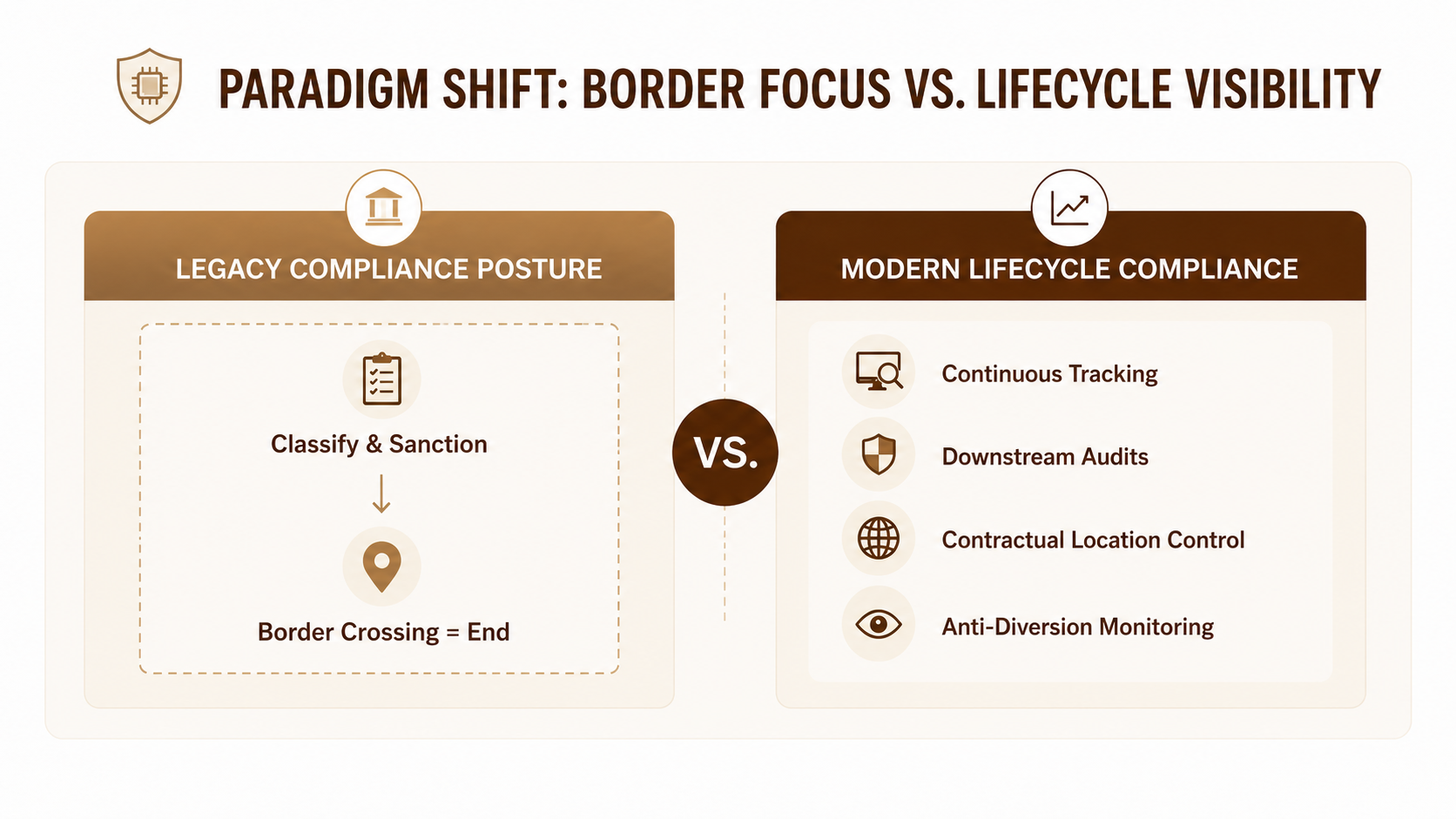
The Strategic Impact: If location-aware parameters become standard operating procedure, relying solely on a clean point-of-sale invoice is legally insufficient. You must maintain visibility into your distributors, resellers, and international transshipment points.
Actionable Next Steps:
- Tighten end-use and end-user diligence on advanced-computing sales especially to distributors and resellers.
- Conduct targeted risk assessments on sales routing through traditional global logistics hubs.
- Strengthen contractual controls (end-use certifications, no-resale and on-site verification clauses) so you have leverage and a record if questions arise.
- Watch transshipment hubs flagged in current enforcement, and treat orders routed through them as red flags warranting extra scrutiny.
Obtaining export licenses in a high-scrutiny climate requires proving where your products stay, not just where they started. Incorporate lifecycle visibility into your transaction design.
Key Points
What does the shift from point-of-sale compliance to lifecycle visibility actually require organizations to build, and why is this a fundamentally different compliance problem than traditional export authorization?
Lifecycle visibility is not an extension of existing compliance programs — it is a structurally different compliance challenge that requires capabilities traditional export authorization programs were never designed to provide:
- Post-export monitoring infrastructure requiring active visibility into chip deployment locations and operational contexts that compliance programs built around pre-export authorization have no mechanism to provide — Traditional export compliance programs are designed to authorize transactions before they occur — confirming classification, screening counterparties, and obtaining licenses before goods cross a border; lifecycle visibility requires a compliance infrastructure that maintains awareness of where chips are after export, how they are being used, and whether deployment remains consistent with the authorized end use — an ongoing operational capability rather than a transaction-point authorization process whose job is complete at shipment.
- Distributor and reseller visibility programs addressing the specific lifecycle tracking gap created when chips move through distribution channels that separate the original exporter from the ultimate deployment location — Organizations that sell advanced AI chips through distributors and resellers lose direct visibility into downstream deployment at the point of distributor sale; lifecycle compliance requires mechanisms that restore this visibility — through contractual reporting obligations, periodic deployment confirmation requirements, and in some cases technical tracking capabilities — rather than treating distributor sales as the end of the compliance obligation at the point where deployment location uncertainty begins.
- Contractual leverage as a lifecycle compliance tool requiring end-use certifications, no-resale clauses, and on-site verification rights that must be negotiated into commercial agreements before transactions close — Lifecycle visibility depends on contractual mechanisms that give the exporting organization the legal right and practical ability to verify downstream deployment; these mechanisms — including end-use certifications that specify authorized deployment locations, no-resale clauses that restrict transfer without authorization, and on-site verification rights that allow physical deployment confirmation — must be built into commercial agreements at the transaction design stage rather than sought after compliance concerns arise when the commercial relationship provides no leverage for imposing new obligations.
- Transshipment point monitoring requiring active intelligence about which logistics hubs are flagged in current enforcement and systematic evaluation of whether proposed routing through those hubs is commercially justified — The Chip Security Act's anti-diversion focus reflects enforcement awareness that diversion most commonly occurs at transshipment points where chips change hands outside the visibility of the original exporter; compliance programs must build active monitoring of transshipment hub enforcement intelligence and integrate routing evaluation into transaction review — treating orders routed through flagged hubs as red flags requiring enhanced scrutiny rather than commercially neutral logistics choices.
- Documentation architecture designed to demonstrate lifecycle compliance rather than only point-of-sale authorization in an enforcement environment where proving where products stay is as important as proving where they started — Enforcement in a lifecycle visibility framework evaluates the evidence of ongoing deployment compliance rather than only the adequacy of pre-export authorization; documentation programs must be designed to create contemporaneous records of deployment location verification, end-use monitoring, and distributor compliance throughout the chip's operational life — records whose absence in an enforcement context signals lifecycle compliance failure regardless of how complete the pre-export authorization documentation is.
How should organizations approach distributor and reseller risk in the context of lifecycle visibility requirements, and what due diligence and contractual mechanisms does this relationship tier require?
Distributor and reseller relationships are the primary lifecycle compliance vulnerability for advanced AI chip exporters — because they are the channel through which exporter visibility into downstream deployment is most commonly lost and through which diversion networks most commonly operate:
- Distributor qualification programs extending beyond restricted party screening to assess downstream customer base, geographic distribution, and end-use monitoring practices as lifecycle compliance prerequisites — Distributors whose downstream customer base includes entities in high-risk jurisdictions, whose distribution geography extends into transshipment-prone regions, or whose own compliance programs do not include end-use monitoring at the point of customer sale present lifecycle compliance risks that restricted party screening of the distributor alone cannot detect; distributor qualification must assess the compliance posture of the distributor's downstream distribution rather than only the distributor's own restricted party status.
- Contractual flow-down requirements obligating distributors to impose lifecycle compliance standards on their own customers that are consistent with the original exporter's obligations — Distributors who accept lifecycle compliance obligations in their agreements with the original exporter but do not flow those obligations down to their own customers create a compliance gap at precisely the tier where diversion risk is highest; contractual flow-down provisions that require distributors to impose end-use certifications, deployment location reporting, and no-resale restrictions on their customers extend the lifecycle compliance framework through the distribution tier rather than allowing it to terminate at the distributor relationship boundary.
- Periodic compliance attestation requirements from active distributors providing ongoing confirmation of downstream deployment status rather than relying on initial transaction documentation — Distributor compliance attestations obtained at the time of sale provide a snapshot of intended deployment that does not account for subsequent ownership changes, inventory movement, or customer resale; periodic attestation requirements — including quarterly or annual distributor certifications of downstream deployment status for advanced AI chip inventory — create a compliance record that reflects ongoing deployment reality rather than only initial transaction intent.
- Reseller red flag indicators requiring enhanced scrutiny for distributor customers whose order patterns, geographic profiles, or end-use representations are inconsistent with legitimate advanced computing deployment — Resellers who order advanced AI chips in quantities inconsistent with their stated end-use scale, who request delivery to locations inconsistent with their stated deployment environment, or who exhibit the behavioral red flags associated with procurement network activity present lifecycle compliance risks that standard distributor sales processing is not designed to detect; compliance programs must extend red flag recognition and escalation procedures to the distributor-customer transaction level through distributor compliance requirements rather than treating the distributor relationship as a compliance boundary.
- Distributor relationship termination protocols for compliance failures that include inventory disposition procedures addressing the lifecycle compliance status of chips already in the distribution channel — When a distributor compliance failure is identified — including unauthorized resale, deployment location misrepresentation, or flow-down obligation breach — compliance programs must address not only the future of the distributor relationship but the lifecycle compliance status of chips already in the distribution channel; inventory disposition procedures that require return, confirmed deployment verification, or government notification for distributed inventory whose compliance status is uncertain are a required element of distributor termination protocols in a lifecycle visibility framework.
What transshipment hub risk management capabilities do current enforcement patterns and the Chip Security Act's direction require, and how should organizations operationalize transshipment risk assessment?
Transshipment hub risk is the enforcement priority that most directly reflects the gap between point-of-sale compliance and lifecycle visibility — and operationalizing transshipment risk assessment requires capabilities that most compliance programs have not previously needed to develop:
- Enforcement intelligence monitoring maintaining current awareness of which transshipment hubs are flagged in BIS enforcement actions, industry advisories, and government guidance rather than relying on static risk assessments based on historical patterns — Transshipment diversion networks adapt to enforcement focus by shifting to less-scrutinized logistics hubs when previously used routes attract enforcement attention; compliance programs must maintain current awareness of which specific hubs are actively flagged in enforcement rather than applying static geographic risk assessments that may not reflect current diversion network routing; monitoring that tracks BIS enforcement actions, industry alerts, and government guidance on specific transshipment points provides the current intelligence that static risk frameworks cannot deliver.
- Routing logic evaluation for all advanced AI chip transactions assessing whether proposed shipping arrangements have coherent commercial justification or present transshipment indicators inconsistent with direct legitimate delivery — Transshipment diversion is structurally identifiable through routing arrangements that add geographic complexity, intermediate stops, or logistics hub involvement that has no commercial justification for the stated destination and end use; compliance programs must integrate routing logic evaluation into transaction review — asking whether the proposed shipping arrangement makes commercial sense for the stated transaction or whether it presents the intermediate routing characteristics that diversion schemes require — rather than accepting customer-specified logistics arrangements as commercially determined choices outside the compliance perimeter.
- Transshipment hub order red flag escalation with defined hold and investigation procedures that prevent transaction processing from advancing while hub-related risk is unresolved — Orders routed through flagged transshipment hubs must trigger compliance holds and investigation procedures rather than proceeding to processing while routing concerns are noted but unresolved; escalation procedures must specify the investigation steps required to resolve transshipment hub red flags — including shipping route justification requests, end-user verification, and in some cases logistics provider due diligence — and must maintain transaction holds until the investigation is complete rather than allowing processing to continue on the assumption that the red flag will be resolved.
- Freight forwarder and logistics provider due diligence assessing whether the logistics partners involved in advanced AI chip transactions have documented involvement in prior diversion activity or operate primarily in transshipment-prone markets — Freight forwarders and logistics providers are not passive participants in transshipment diversion — they are operationally essential to the routing schemes that move controlled chips through intermediate hubs; due diligence on logistics partners for advanced AI chip transactions must assess their prior enforcement involvement, their primary operating markets, and whether their involvement in a specific transaction is commercially explained or structurally consistent with transshipment facilitation.
- Post-shipment routing verification confirming that advanced AI chip shipments arrived at authorized destinations rather than being rerouted to undisclosed locations after departure — Lifecycle visibility includes verification that chips shipped to authorized destinations actually arrived there rather than being diverted in transit through post-departure rerouting; post-shipment verification mechanisms — including delivery confirmation requirements, carrier tracking validation, and periodic end-user delivery attestation — provide the transit-phase compliance assurance that pre-shipment routing review cannot supply for shipments whose routing is altered after departure.
How should organizations incorporate lifecycle visibility into transaction design before the Chip Security Act becomes law, and what transaction structuring changes reduce exposure in the current enforcement environment?
Incorporating lifecycle visibility into transaction design is a proactive compliance investment that reduces current enforcement exposure while building the capability that pending legislation will require — and the transaction structuring changes that achieve this are available now regardless of legislative outcome:
- End-use certification design that specifies authorized deployment location with facility-level specificity rather than country or organization-level generality that cannot support deployment verification — End-use certifications that identify only the destination country or the purchasing organization's general business type cannot support the deployment location verification that lifecycle compliance requires; certifications must identify the specific facility, data center, or installation where chips will be deployed — with address-level specificity that enables physical verification — rather than providing geographic or organizational descriptions that are consistent with multiple deployment scenarios including unauthorized ones.
- No-resale and transfer restriction clauses with defined authorization processes that create a contractual record of the exporter's lifecycle compliance expectations and the customer's acceptance of those obligations — No-resale clauses that prohibit unauthorized transfer of advanced AI chips without exporter notification and in some cases government authorization create a contractual framework for lifecycle compliance that gives the exporter both legal leverage and a documented compliance record if downstream transfer activity is later scrutinized; these clauses must include defined processes for requesting transfer authorization rather than only prohibiting transfer, to provide a practical mechanism for legitimate secondary transactions that maintains compliance visibility.
- On-site verification rights negotiated into commercial agreements providing the contractual basis for physical deployment confirmation that lifecycle visibility may require — The ability to physically verify that advanced AI chips are deployed in authorized locations requires contractual access rights that must be negotiated before transactions close; on-site verification rights that allow the exporter or its designated representative to confirm deployment location and use provide the physical verification capability that documentary evidence alone cannot supply — but these rights are only available if they were built into the commercial agreement rather than sought after compliance concerns arise.
- Transaction documentation designed to create a contemporaneous lifecycle compliance record rather than only a point-of-sale authorization record — Transaction files for advanced AI chip sales should include not only pre-export authorization documentation but the end-use certifications, deployment location specifications, contractual compliance obligations, and post-delivery verification records that demonstrate lifecycle compliance from authorization through deployment; documentation designed around the lifecycle compliance framework creates the evidentiary record that enforcement review in a post-Chip Security Act environment will evaluate rather than only the pre-export authorization record that current enforcement already scrutinizes.
- Licensing strategy that incorporates lifecycle visibility evidence as a license application component demonstrating to BIS that the transaction is designed to maintain authorized deployment rather than creating the conditions for diversion — In a case-by-case licensing environment where BIS evaluates the transaction's full compliance posture rather than only its classification and destination eligibility, license applications that demonstrate lifecycle visibility mechanisms — including deployment location specificity, contractual controls, and monitoring commitments — present a stronger compliance case than applications that address only pre-export authorization; incorporating lifecycle compliance design into licensing strategy treats the license application as an opportunity to demonstrate compliance program maturity rather than only to seek transaction authorization.
What does the Chip Security Act signal about the long-term trajectory of advanced technology compliance, and how should strategic leaders position their compliance programs for the regulatory environment that is clearly coming even if its specific form remains uncertain?
The Chip Security Act's direction — regardless of its specific legislative outcome — signals a compliance trajectory that strategic leaders can position for now rather than react to when specific requirements take final form:
- Defense article treatment of advanced compute as the endpoint of a regulatory trajectory that is already visible in current enforcement priorities, legislative proposals, and policy statements — The convergence of lifecycle visibility requirements, beneficial ownership screening obligations, case-by-case licensing review, and congressional oversight proposals reflects a policy direction toward treating advanced AI compute with the same compliance seriousness as defense articles — imposing end-use monitoring, retransfer restrictions, and post-deployment verification obligations that ITAR imposes on defense exports; strategic leaders who position their compliance programs for this trajectory now are building capabilities that will be required regardless of which specific legislative vehicle carries these requirements into law.
- Compliance program investment made before specific requirements are finalized retaining full value while providing immediate protection against current enforcement — The lifecycle visibility, distributor controls, and transshipment monitoring capabilities that Chip Security Act preparation develops are directly valuable under current BIS enforcement priorities regardless of legislative outcome; compliance investment made in anticipation of pending requirements is not speculative — it addresses current enforcement risks while positioning organizations for regulatory requirements whose direction is clear even when their specific form remains uncertain.
- Competitive differentiation through compliance maturity in a market where customers, partners, and government clients increasingly evaluate compliance program quality as a qualification criterion — Advanced AI chip markets are increasingly populated by buyers — including government agencies, regulated industries, and compliance-conscious enterprises — who evaluate the compliance maturity of their technology suppliers as a qualification criterion; organizations whose compliance programs demonstrate lifecycle visibility, ownership monitoring, and proactive regulatory adaptation present a compliance posture that differentiates them from competitors whose programs are designed around prior regulatory standards.
- CTP's thirty-plus years of compliance engineering across ninety-plus countries providing the external intelligence and implementation capability that internal programs cannot develop alone in a regulatory environment changing at current speed — The regulatory change pace in advanced compute export controls — with rules written, rescinded, patched, and re-debated within eighteen months — exceeds what most internal compliance programs can monitor and respond to without external support whose regulatory intelligence, government relationships, and cross-industry enforcement visibility complement internal capabilities; strategic leaders who build external advisory relationships now are positioning their organizations to absorb the next regulatory development rather than react to it after implementation timelines have already compressed.
- The organizations that navigate the next compliance cycle well are building now rather than waiting — Strategic leaders who treat each regulatory signal — including proposed legislation, enforcement budget expansion, and policy statements — as actionable intelligence for compliance program development rather than as reasons to await final requirements are building the organizational capability that absorbs regulatory change; those who wait for specific requirements to take final form will consistently find themselves building compliance infrastructure under the deadline pressure and enforcement scrutiny that proactive investment is specifically designed to avoid.